The $26 million wire a 12-cent check would have stopped
By CAPPZ.AI ·
A New Jersey township wired $26 million for a land purchase to fraudulent instructions. CAPPZ Payee Confirmation checks the instructions are the ones the payee declared and endorsed from its own wallet, holds changes for 72 hours, and costs about 11.7 cents.
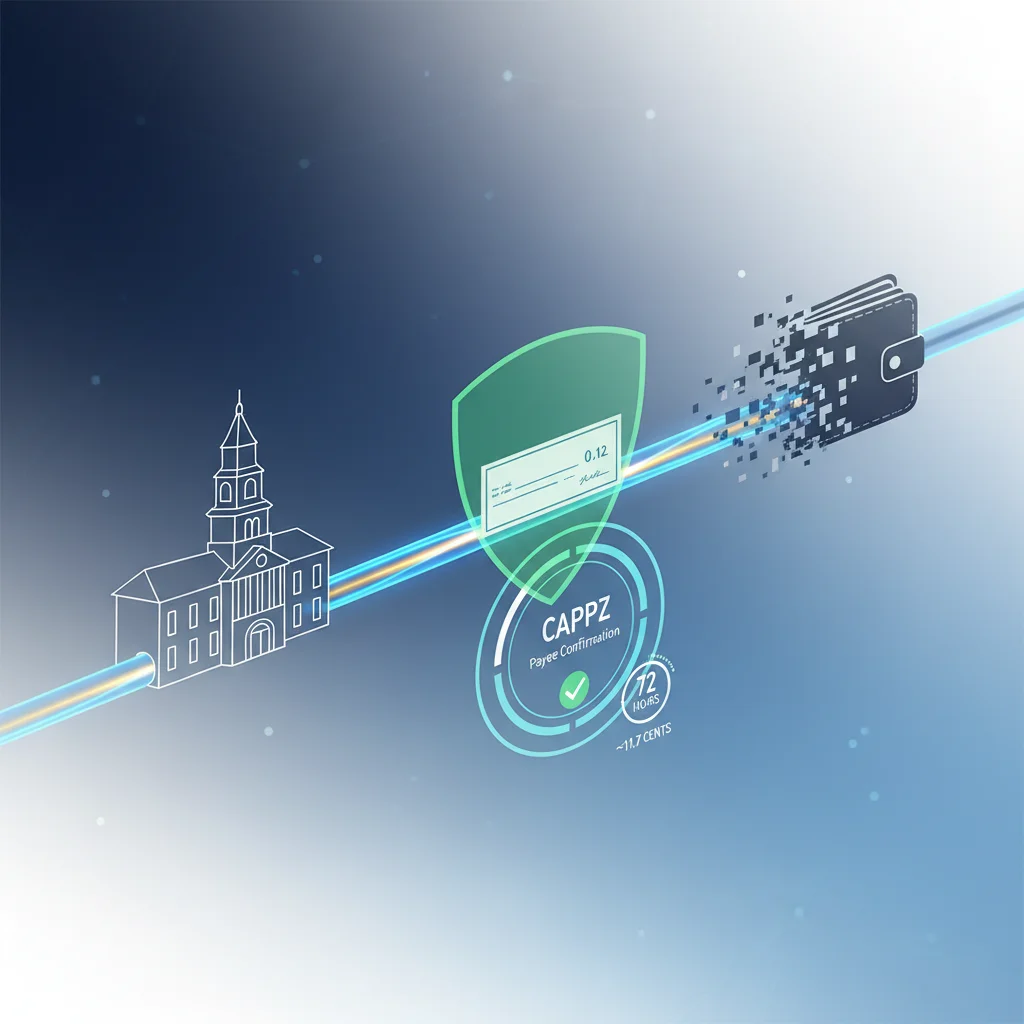
On September 28, Cranbury Township in New Jersey, a village of about 4,000 people, wired $26 million in bond proceeds for a land purchase. According to The Wall Street Journal, the township had received "fraudulent wiring instructions" beforehand, and the money went to the thieves instead of the seller. Police and the FBI seized $17.3 million before it could be moved on. That still leaves nearly $9 million unaccounted for, against a $5 million insurance policy. Residents learned of the theft on November 6. https://www.wsj.com/us-news/the-26-million-cyberheist-rocking-a-small-new-jersey-town-bbe2ae6d
At the town meeting one resident asked the obvious question: "I can't even get on my iCloud account without a two-factor identification. I don't know how you would transfer $26 million."
She is right that this is the gap. Every step of a large payment is protected except the one that matters most: whether the account you are about to pay belongs to the person you mean to pay. Banks check that an account exists. Email, at best, checks that a message arrived from a domain. Nobody checks that the payee itself said "pay me here."
Why the usual checks pass
Payment-instruction fraud, also called business email compromise, sends money to a real account that works perfectly. It just belongs to someone else. A spoofed or hijacked email arrives at the right moment with "updated" instructions. The account is open, the transfer is accepted, and every system involved reports success.
The same pattern now appears on blockchains as address poisoning. An attacker sends you a tiny payment from an address that shares the first and last characters of one you pay often. Next time you copy an address from your history, you copy theirs.
Checking that an address exists does not help, because the fraudster's address exists too. CAPPZ already offers a counterparty check that says whether an XRP Ledger address can receive a payment. That is the wrong question here. The right one is: did the payee declare these instructions?
Payee Confirmation: the payee says where to pay it
New in the open-source CAPPZ SDK 15.38, Payee Confirmation moves payment instructions out of email and into a record that only the payee can write.
- The payee declares its instructions on the CAPPZ market's public log: an XRP Ledger address and destination tag, or a bank account. Only the payee's own account can write for it. A bank account is published only as a salted fingerprint, never as the number.
- The payee endorses the declaration from its own XRP Ledger wallet. Its wallet sends a transaction that names the declaration and moves no money. Someone who has broken into the payee's email or CAPPZ account cannot produce it without the wallet's key as well. That is the second factor the resident asked for. The ledger timestamps it, and nobody can backdate it.
- New instructions wait 72 hours. If an attacker does take over a payee's account and wallet, the change sits in public for three days before anyone can be paid on it, and the payee can revoke it instantly.
Before paying, the payer runs one command with the payee's ID from the contract and the instructions it was given:
cappz-market confirm-payee <payee-id> --routing 021000021 --account 987654321 --amount 26000000
Bank details are fingerprinted on the payer's own computer; the number is never sent. The check returns a signed report:
| What it finds | Verdict |
|---|---|
| The instructions are not among the payee's declarations | Stop: the payee never declared them |
| The instructions were declared by a different party | Stop: this is the fraud pattern |
| Declared, but still inside the 72-hour hold | Stop until the hold ends |
| Revoked, replaced or expired | Stop |
| An address that looks like one you paid before but is not | Stop: address poisoning |
| Different from where you paid this payee last time | Warning: confirm by phone at a number you already had |
| Declared, endorsed and past the hold | OK, with advice to get a second approver and send a small first payment |
How it would have played out in Cranbury
The details of the crime are still under investigation, so this is the general shape. Fraudulent wiring instructions arrive. The township's finance office runs the check against the seller's ID from the purchase contract, before anyone wires anything:
- If the seller had declared its account, the fraudulent account is not among its declarations. Stop.
- If the fraudster had broken into the seller's email and tried to declare new instructions, it would also need the seller's wallet key. Even with both, the change is held in public for 72 hours. Stop.
- If the seller had declared nothing at all, the check says so. Stop, until the seller declares through the market.
In every case, the report tells the payer to call the seller on a number it already had, never one in the message carrying the instructions.
The report's advice addresses the other failure the meeting exposed. Cranbury had relied on one person serving as chief financial officer, finance director and town administrator. Every report recommends that a second person approve the payment against it, and that a large amount go first as a small test transfer the payee confirms back.
One limit should be clear: CAPPZ can confirm that the payee declared and endorsed a bank account, but only the bank can confirm the name on that account. The report says so, and recommends asking the bank for an account-name check as well.
What it costs
| Item | Paid by | Amount |
|---|---|---|
| Platform fee, paid before the check runs | Payer | 0.01 XRP |
| Service fee, paid once the signed report is ready (its fingerprint is shown before you pay) | Payer | 0.1 XRP |
| XRP Ledger network fees for those two payments | Payer | about 0.00002 XRP |
| Total per confirmation | 0.11002 XRP ≈ $0.117 | |
| Declaring and endorsing instructions | Payee | about 0.000012 XRP in network fees, with no reserve held |
Assumption: XRP at $1.06, its price on November 11, 2026. The check costs less than 12 cents while XRP is below about $1.09.
Against $26 million, that is about one cent for every $2.2 million wired.
Tested on the live test network
We ran the full flow on the XRP Ledger testnet with real transactions. A payee declared and endorsed instructions, then replaced them. A fraudster with a lookalike company name declared its own address. A payer paid both fees and received a signed report.
| Case | Result |
|---|---|
| New instructions, minutes after endorsement | Stop: still in the 72-hour hold |
| The same instructions, checked 73 hours later | Confirmed, with control of the receiving address proven |
| The replaced instructions | Stop: replaced |
| The fraudster's address presented as the seller's | Stop: declared by another party |
| The right address with a tag the payee never declared | Stop: not declared |
Every case also warned that the instructions differed from where the payer had paid before, and that another party used a lookalike name.
Try it
- Payees:
cappz-market payee declare --address r… [--tag n], or a bank account with--routing,--accountand--hint. Put your party ID in your contracts. - Payers:
cappz-market confirm-payee <payee-id> …before any large or first payment. - Agents: the confirming-payees skill.
- The rules are public in payeeConfirmation.ts (Apache-2.0). Anyone can re-run them on a report's facts and get the same verdict.
A town that has wired the same seller for years and a company paying a new supplier face the same question before every large payment: did the payee tell us to pay here? For about 12 cents, the answer can come from the payee instead of from an email.
Topics: payee confirmation, wire fraud, business email compromise, payment instructions, municipal finance, xrp ledger, address poisoning, cappz marketplace
Version 1 · recorded on the CAPPZ admin chain · content sha256 0cd2045db5073af2