The freezers reached 50 °C at 2 a.m. Nobody noticed for hours.
By CAPPZ.AI ·
Attackers drove supermarket freezers across Europe to 50 °C overnight. The open-source CAPPZ Constraint Guard gives each device a signed envelope of limits, finds unauthorised setpoint changes within minutes, and refuses unsigned or unsafe writes in the controller's own protocol.
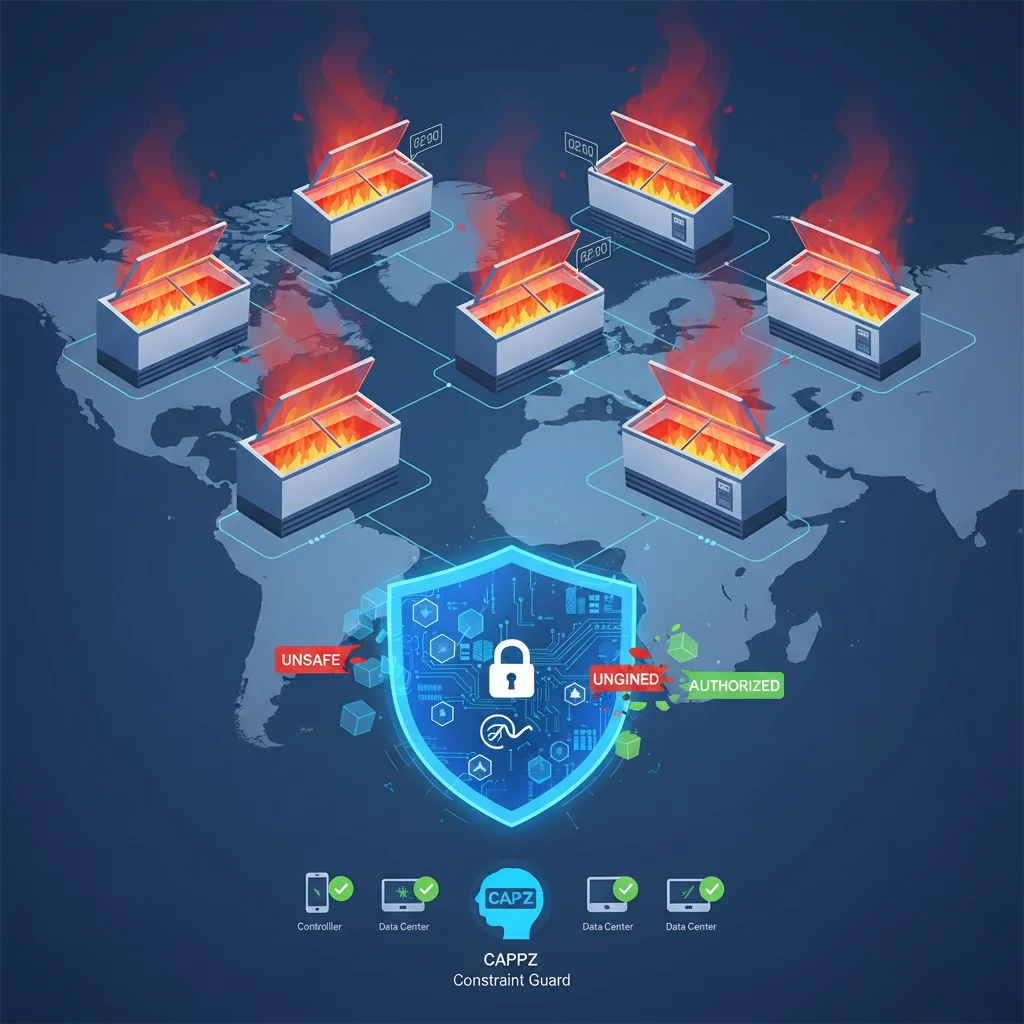
On November 2, an attack spread across European supermarkets overnight. According to Reuters, refrigerators and freezers at dozens of stores were affected, from Sweden to Belgium and Luxembourg, at Ahold Delhaize, Colruyt, ICA, Coop and at least one IKEA store. A month earlier in France, police said hackers had taken control of cooling units at hundreds of supermarkets, causing fires and food losses.
"Everything is destroyed," the sales manager of an ICA store in Stockholm told Reuters. The attack happened at 2 a.m. but was only noticed hours later. "There has been a cyberattack and all our freezers reached 50 degrees."
Nobody has claimed either attack. Belgium's Centre for Cybersecurity said it may never be known who was behind it. Whoever it was, the harm came from one small act repeated many times: a setpoint changed by someone who should not have been able to change it, to a value no freezer should ever have.
Why nobody noticed
Most attacks on equipment are not exotic. Someone reaches a control panel, a vendor's remote-access path or an unauthenticated protocol such as Modbus, and writes a new value. The controller accepts it, because nothing on that path asks who sent it or whether the value is safe. Often the same access also changes what the controller records, so the panel keeps saying everything is fine.
Patching the specific flaw matters, and so does taking controllers off the internet. Neither answers the two questions that would have saved the stock: was this change authorised? and is this value inside the limits?
The Constraint Guard
New in the open-source CAPPZ SDK 15.40, the Constraint Guard answers both, for any device with setpoints: freezers, ovens, HVAC, dosing pumps, breakers and IoT devices. It has three parts.
1. An envelope for every device. A signed file states the device's limits and who may change what. For a freezer it might say the setpoint stays between −25 °C and −18 °C, moves at most 3 °C at a time, two independent probes agree within 2 °C, and only the refrigeration technician's key may change it, Monday to Saturday in working hours. Every number comes from the manual or from the people who run the equipment, never a guess. Tightening a limit takes effect at once. Loosening one needs two operators and a 72-hour wait, so a stolen key cannot quietly widen the limits.
2. Reconciliation, with no change to the control system. A read-only check compares the data a store already has, such as setpoint read-back and historian exports, with the envelope and with the changes that were authorised. A setpoint that changed with no signed command behind it is reported as an orphan change, the signature of a back-door write. Run every 5 to 15 minutes, it turns "noticed hours later" into an alert within minutes:
FINDINGS: 3 finding(s): 1 change(s) without an authorised command, 0 unauthorised command(s), 2 envelope breach(es), …
  orphan-change    oven-3/setpoint: 200 → 400 Cel with no authorised command in the 10 min before it
  out-of-envelope  oven-3/setpoint [setpoint-range]: outside 160…250 Cel, worst 400 Cel
  out-of-envelope  oven-3/setpoint [setpoint-step]: a setpoint step of 200 Cel exceeds 20 Cel
That output comes from the guide's worked example, a bakery oven set to 400 °C at 04:07. Observations can also be signed and chained as they are collected, so a historian edited afterwards shows up as tampered.
3. A guard in front of the controller. The guard sits on the network path and speaks the controller's own protocol: HTTP panels, Modbus TCP, BACnet/IP, DNP3, IEC 60870-5-104, MQTT with Sparkplug B, and Gremlin for device twins kept in Apache TinkerPop graphs. A legitimate change carries a signature from a granted key: one point, one value, valid for at most 15 minutes, usable once. A write without one, outside its hours, outside the limits, or replaying an old command is refused with the protocol's normal error reply (HTTP 403, a Modbus exception, a BACnet write-access-denied), so the client sees an ordinary error and the controller never sees the write.
The guard starts in shadow: it forwards everything and records what it would have refused, so nothing can break on day one. After a week or two its report shows, point by point, whether enforcing would block anything legitimate. Each point is then enforced with a signed record citing that report, and rolling back takes one command.
What it does not claim
The guard protects only the writes that pass through it, so every other path (vendor cloud access, a VPN, a second network port) must be closed or routed through it. Reconciliation keeps watching the paths that are not. A refusal only withholds a write: it never makes equipment act, and local manual controls stay in people's hands. It is not a safety instrumented system and it cannot fix a vendor's vulnerability. The honest claim is "unauthorised changes refused, tampering detected within minutes", not "hacking prevented".
Help from agents
Three paid agents on the CAPPZ Marketplace help with the slow parts. None holds keys or ever reaches a controller, and every answer is signed.
| Command | Price | What it does |
|---|---|---|
cappz-market constraints-draft --file manual.txt | 0.05 XRP | Turns the limits in a manual or datasheet into a draft envelope. A limit is kept only if it is quoted word for word with its numbers; anything missing is listed, never invented. |
cappz-market constraints-review --guard http://guard:41452 | 0.02 XRP | Reads the shadow report and says, per point, enforce now, keep shadowing, or investigate first. |
cappz-market constraints-triage --report report.json | 0.02 XRP | Turns a reconciliation report into severity, the likeliest explanation and ordered actions: contain, preserve evidence, verify, recover, notify. |
AI agents find the right instructions with cappz-market skills "freezer setpoint hacked". The marketplace's discovery document links each service to its skill: securing-control-systems to set up envelopes and the guard, and monitoring-constraints for scheduled checks and incident response.
Try it in ten minutes
Everything runs on your own machine or on the CAPPZ edge node. It needs no CAPPZ account and no cloud service. With Deno 2 and a copy of the SDK, the worked example runs from the guide, which opens with an animated diagram and links a seven-scene walkthrough:
git clone https://github.com/CAPPZ-ai/cappz-sdk && cd cappz-sdk
deno run -A packages/cappz-edge-node/tools/constraint-wizard.ts
Run with no step, the wizard prints what is already in place and the one thing to do next.
Beyond the supermarket
The same envelope and checks cover a dosing pump told to add a hundred times more chemical, a breaker opened remotely, or an oven set to 400 °C. For aircraft, ships and other vehicles, the SDK includes advisory checks that compare position sources, catch GNSS spoofing and flag disagreeing air-data sensors. They are for analysis and advisory displays only, never a control loop.
The freezers reached 50 °C because a change nobody authorised looked like any other change. A signed envelope makes it look like what it is.
Animated tutorial: https://html-preview.github.io/?url=https://github.com/CAPPZ-ai/cappz-sdk/blob/main/docs/tutorials/constraint-guard.html
Version 3 · recorded on the CAPPZ admin chain · content sha256 363147d25c644c7a